Dirty Hands Clean Money SVG
A Designer’s First Look: Bold, Playful, and Built for Real Work
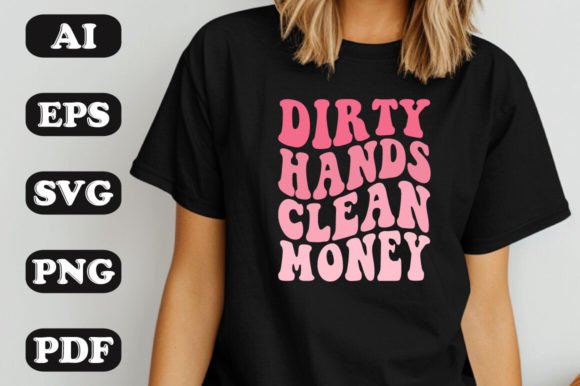
When I opened Dirty Hands Clean Money SVG for the first time, my eye went straight to the contrast—rough, hand-drawn lettering paired with a clever visual twist: smudged fingerprints doubling as dollar signs. It’s not just witty; it’s tactile. The design feels grounded in craft culture—not corporate, not ironic, but authentically proud of making things. That tone matters deeply when you’re stitching it onto a handmade apron for a local bakery owner or embroidering it on a baby onesie for a maker mom who runs her own ceramics studio.
Where This Design Truly Shines
I tested Dirty Hands Clean Money SVG across several real projects: a heavyweight cotton tote for a small woodworking shop, a loopback sweatshirt for a weekend craft fair vendor, and a linen tea towel for a boutique kitchen goods line. In each case, the design held up—not because it’s overly complex, but because its intentional simplicity translates well in stitch.
- Embroidered patch: Works beautifully as a sew-on or iron-on badge—clean outlines hold shape, and the open negative space between letters prevents fill-stitch crowding.
- Sweatshirt embroidery: Stitches cleanly on mid-weight fleece without excessive stabilizer, especially when sized between 3.5"–4.5".
- Tote bag design: Looks sharp centered on the front panel of a 15" canvas tote—no distortion, no thread piling, even after repeated washing.
- Personalized gift: Paired with a short name or date (e.g., “JEN • 2024”), it reads as warm and human—not generic.
Where to Pause—and Plan Ahead
This isn’t a one-size-fits-all machine embroidery design. Its charm lives in its texture and imperfection, so some surfaces demand extra attention:
- Small hoop sizes (under 4”): The lowercase “a” and “g” have subtle curves that can blur if shrunk too far—aim for no smaller than 3” wide on finished embroidery.
- Stretchy fabric: On lightweight jersey tees, use cutaway + tear-away combo stabilizer. The letterforms rely on clean edges—stretch distorts those lines fast.
- Dark fabric: The design includes no built-in drop shadows or outlines—so for black or navy, add a simple satin-stitch border in white or gold thread during digitizing. Don’t assume the PNG mockup shows how it’ll read in stitch.
- Curved surfaces (caps, beanies): The horizontal layout doesn’t wrap naturally—best avoided unless repositioned vertically or broken into two stacked lines.
- Frequent-wash items (baby clothes, kitchen towels): Keep stitch density moderate. Overly dense fills in the “$” symbol or fingerprint details can stiffen fabric and wear unevenly.
What It Adds to Your Finished Product
Dirty Hands Clean Money SVG does more than decorate—it signals values. When stitched on an apron for a candlemaker or embroidered on a pillow cover for a DIY home studio, it quietly says: *I make things. I’m proud of the work. I value craft over shortcuts.* That resonance boosts perceived product value, especially for Etsy sellers and small shop owners building brand consistency through handmade authenticity.
Customers notice the difference between a crisp, confident stitch-out and one where lettering blurs or spacing collapses. This design rewards careful hooping and thoughtful thread selection—especially when using matte cotton or tonal polyester threads that echo its earthy, grounded mood. It also scales well into printable mockups: the SVG and PDF files let you preview confidently on light and dark backgrounds before committing to fabric.
Practical Notes Every Embroidery Designer Should Check
Before adding Dirty Hands Clean Money SVG to your next craft business project, run these checks:
- Test on scrap fabric first—especially if using textured weaves like burlap or terry cloth.
- Review thread color contrast—this isn’t a high-contrast graphic by default, so choose thread that lifts off the background, not sinks into it.
- Confirm hoop size compatibility—the Ai 10 and EPS 10 files are vector-based, but your actual embroidery file may need resizing depending on your machine’s native format.
- Inspect small details—zoom in on the fingerprint swirls and dollar sign loops. If your digitizer plans to convert this to a machine embroidery design, ensure those curves translate cleanly at your target size.
- Try black-and-white mockups—it reveals balance issues invisible in color previews.
- Use proper stabilizer—lightweight cutaway works best for most cotton and linen applications; avoid basic tear-away for anything above 50% fill density.
- Verify licensing—since this is listed as a Graphics file set (not pre-digitized), confirm whether commercial use of stitched items or resale of the digital embroidery file itself is permitted under the seller’s terms.
Final Thought: A Design That Earns Its Place
Dirty Hands Clean Money SVG isn’t flashy—but it’s memorable. It fits naturally into the rhythm of real embroidery work: no over-engineered gradients, no fragile fine lines, no unnecessary embellishment. It respects the process. Whether you’re stitching it on a holiday gift for a fellow maker, branding a batch of small shop merchandise, or creating a custom embroidered patch for a trade show booth, it carries weight—not because it shouts, but because it means something. And in a market crowded with generic T-Shirt Designs, that kind of quiet intention is rare. Use it thoughtfully, test it honestly, and let the hands doing the work speak for themselves.