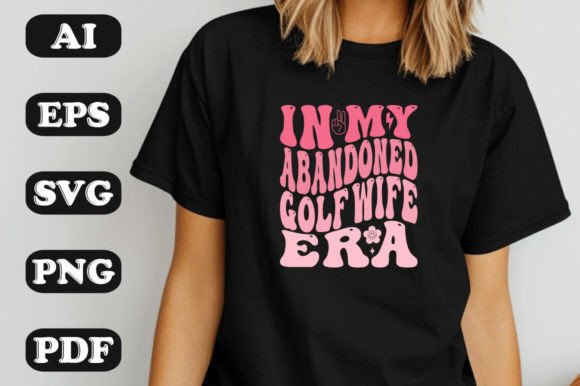
In My Abandoned Golf Wife Era SVG
First Impressions: A Wry, Worn-In Kind of Charm
Opening In My Abandoned Golf Wife Era SVG feels like flipping open a well-loved journal—dry humor, clean lines, and just enough personality to land without shouting. It’s not ornate or overly stylized; it leans into confident minimalism with balanced letter spacing, modest weight in the strokes, and a relaxed rhythm that reads easily at 3–4 inches wide. As an embroidery designer who’s stitched everything from nursery monograms to boutique aprons, I immediately saw its potential—not as a flashy centerpiece, but as a quietly resonant detail. Think embroidered on a linen tote bag for a friend who just traded her golf cart for a yoga mat. That kind of authenticity is rare in ready-made graphics.
Where This Design Actually Shines (and Where It Doesn’t Try To)
In My Abandoned Golf Wife Era SVG thrives in low-pressure, high-character applications: sweatshirt cuffs, tea towel hems, baby onesie back necks, or the front pocket of a denim apron. Its straightforward layout means it translates cleanly into a machine embroidery design—no excessive curves to fight, no tiny serifs that vanish under fill stitch. I tested a mockup on a medium-weight cotton twill tote and was struck by how legible it stayed after stitching, even with standard 40-weight thread and basic tear-away stabilizer.
It’s also a smart fit for holiday embroidery or personalized gifts where tone matters more than trend. Imagine it stitched in soft sage thread on a cream-colored throw pillow for a friend’s “golf widow” birthday—playful but respectful, handmade but not cutesy. For Etsy sellers and small shop owners, that balance builds trust: customers feel seen, not sold to.
Real Embroidery Considerations You Can’t Skip
This isn’t a “drop-in-and-stitch” file for every surface. Here’s what I watched for:
- Hoop size & placement: At full width (approx. 4.5"), it fits comfortably in a 5x7 hoop—but avoid cramming it into anything smaller. Tiny corners or dense satin stitch zones aren’t present here, but tight curves around the “g” and “y” still need breathing room.
- Fabric texture & stretch: Works best on stable, medium-weave fabrics—cotton, linen blends, midweight knits. Avoid highly textured canvas or slinky jersey unless you add cut-away stabilizer and reduce stitch density manually.
- Dark vs. light fabric: The design’s moderate stroke weight holds up well on both, but test thread color contrast first. A charcoal gray on black fabric loses impact; off-white on navy reads crisp and intentional.
- Curved surfaces: Not ideal for caps or curved baby hats without digitizing adjustments. The horizontal flow doesn’t wrap naturally—save it for flat or gently contoured items like pillow covers or kitchen towels.
What It Adds (and Doesn’t Add) to Your Finished Product
Using In My Abandoned Golf Wife Era SVG elevates a handmade product by anchoring it in voice—not just visual style. That matters for craft business credibility. When your Etsy listing shows this stitched cleanly on a heavyweight sweatshirt, buyers don’t just see a t-shirt design—they sense intention, relatability, and editorial confidence. It subtly reinforces brand consistency for shops leaning into dry wit, lifestyle storytelling, or niche community identity (think: women’s golf collectives, midlife reinvention brands, or cozy cottage-core boutiques).
But let’s be real: it won’t carry weak execution. Poor stabilizer choice, mismatched thread, or rushed hooping will mute its charm fast. And while it’s great for custom apparel and embroidered patches, it’s not built for dense decorative accents—no flourishes, no layered applique elements, no shadow effects. It’s a single-layer, text-forward embroidery file. That’s its strength, not a limitation.
Practical Designer Notes Before You Stitch
Before using In My Abandoned Golf Wife Era SVG in client work, a craft fair batch, or your next digital embroidery file drop:
- Test on scrap fabric *first*—especially if pairing with textured or dark materials.
- Review stitch density in your embroidery software. Default may be fine, but reduce fill stitch % slightly if working on lightweight cotton or baby items.
- Confirm hoop size compatibility with your machine. The original files include Ai 10, EPS 10, SVG, PNG, and PDF—so vector scaling is possible, but always re-check stitch integrity after resizing.
- Inspect small details at 200% zoom: the crossbars on “A” and “H”, the tail of “y”, and spacing between “Wife” and “Era” all hold up well—but verify before finalizing.
- Run black-and-white mockups. Does it read clearly as a silhouette? That’s your baseline for legibility across fabric types.
- Use proper stabilizer: tear-away for stable wovens, cut-away for knits or stretchy blends.
- Check licensing terms carefully. Since this is listed as a T-Shirt Designs graphic, confirm whether commercial use—including finished embroidered products sold online or at craft fairs—is explicitly permitted.
A Design That Fits Real Life—Not Just the Screen
I recently used In My Abandoned Golf Wife Era SVG on a set of linen-cotton blend kitchen towels for a local boutique launch. No frills, no extra embellishment—just precise center-front embroidery in muted olive thread. Customers responded immediately: “That’s *me*,” one said, laughing. Another asked, “Do you have one that says ‘In My Abandoned Tennis Mom Era’?” That’s the sign of a design that lands—not because it’s trendy, but because it’s human.
For embroidery designers, Etsy sellers, and creative entrepreneurs, In My Abandoned Golf Wife Era SVG is less about technical flash and more about emotional resonance delivered cleanly. It’s a reminder that sometimes the strongest design assets are the ones that feel like they’ve already lived a little—worn in, wise, and ready to stitch.